
Caysichite-(Y) Ca4(Y,REE)4(Si8O20)(CO3)6·8H2O: Endmember composition and structure established from new occurrences across different geologic settings
| Reviews and Highlights | Quantum Science | Molecular and Soft-matter | Ultrafast Nano-optics and Nanophotonics | Mineralogy and Geochemistry |
|---|
Benjamin G. Whetten, Hengdi Zhao, Franziska D.H. Wilke, Henrik Friis, Andreas Massanek, Randy Becker, Joseph R. Smyth, and Markus B. Raschke
The Canadian Journal of Mineralogy and Petrology (2026).
DOI PDF
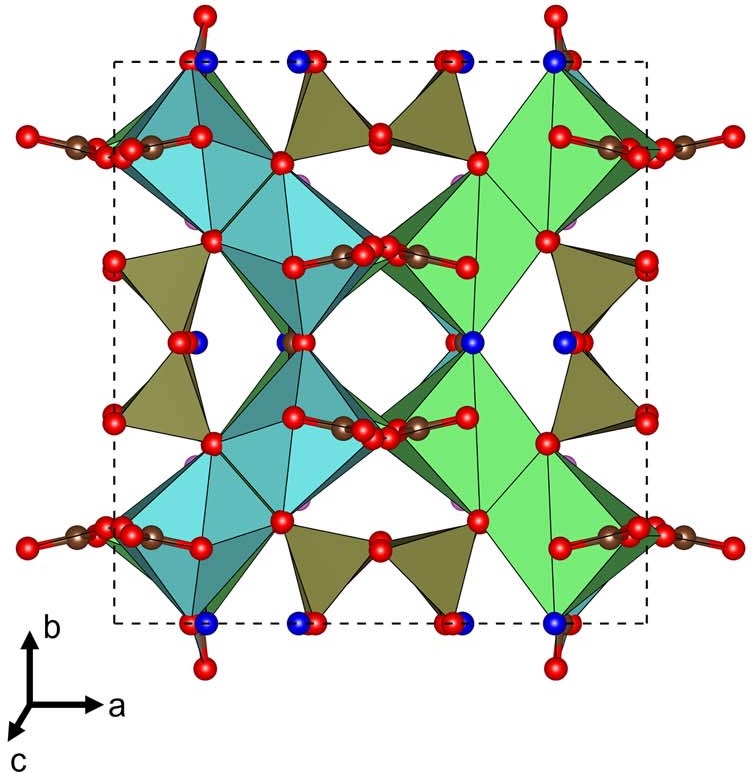
The heavy rare earth element silicate-carbonate mineral caysichite-(Y) [Ca4(Y,REE)4(Si8O20)(CO3)6·8H2O] was discovered in the alkaline granite of the Golden Horn Batholith, near Washington Pass, Okanogan County, Washington, USA, as sub-millimeter euhedral orthorhombic pale white crystals in a single miarolitic cavity in biotite granite. Based on comparative electron microprobe, single-crystal X-ray diffraction, and Raman analyses of caysichite-(Y) from both the Golden Horn and Mount Malosa (Malawi) localities, the ideal endmember composition and space group Pnmn with orthorhombic unit cell parameters a = 13.2577(5) Å, b = 13.9816(5) Å, and c = 9.7440(4) Å was determined. This structure and range of composition is distinct from caysichite-(Y) from the type locality Evans-Lou (Canada), where re-investigation confirms the space group Ccm21, with high REE ΣREE (0.7–1.0) apfu and Al3+(0.02–0.23) apfu in agreement with the original work of Mellini & Merlino (1978) and Hogarth et al. (1974), respectively. In contrast, Golden Horn and Mount Malosa caysichite-(Y), with an absence of Al3+ and ΣREE (0.5–0.8) apfu, exhibit a euhedral crystal habit with distinct Ca-Y site ordering, establishing the ideal endmember composition of Ca4(Y,REE)4(Si8O20)(CO3)6·8H2O. The Evans-Lou composition, close to (Ca,REE)3(Y,REE)5(Si8O20)(CO3)6(OH)·7H2O, derives from the two coupled substitutions Ca2+ + H2O ↔ REE3++ OH− and Si4+ + Ca2+↔ REE3++ Al3+. The substitutions together with the Ca-Y site disorder suggest rapid crystallization from a secondary hydrothermal solution as fine grained acicular crusts, whereas the well-defined Golden Horn and Mount Malosa caysichite-(Y) crystals appear to have derived from late-stage primary fluids.